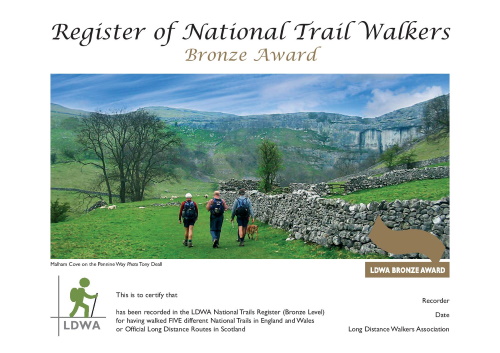
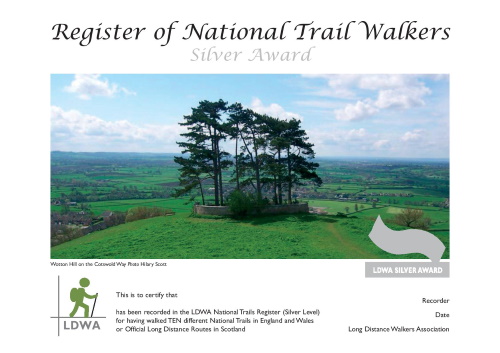
The National Trails Register of walkers of the National Trails in England, Wales and Scotland is maintained on the LDWA website. High-quality commemorative Bronze, Silver and Gold Award Certificates are awarded for completion of, respectively, five, ten and fifteen National Trails (NTs). Completers of all nineteen National Trails qualify for the prestigious LDWA National Trail Diamond Award. At the beginning of 2022 there were over 500 people on the National Trails Register.
The day to day running of the Register and the writing of the annual Strider report are the tasks of the NTs Recorder. The current Register Recorder is Heather Ingram.
The instigator of both the National Trails Register and the Hillwalkers' Register was Alan Castle.
  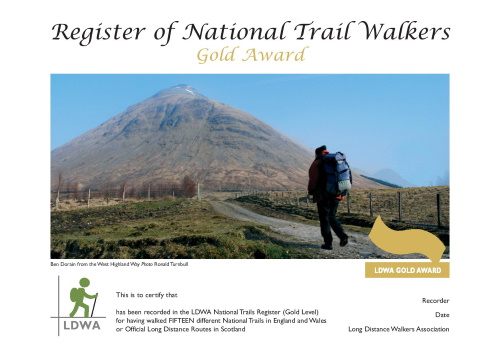 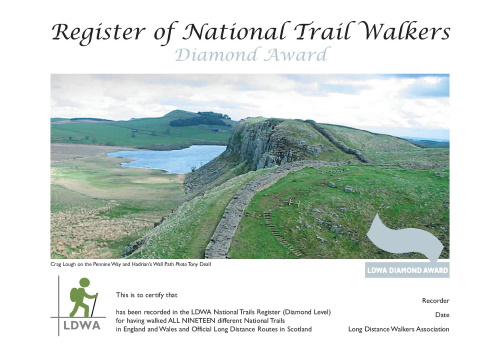 |
For the purposes of the Register, National Trails are defined as the National Trails of England and of Wales that are waymarked with the 'Acorn' logo, plus the official Great Trails of Scotland that carry the 'White Thistle' waymarking.
Included in the nineteen NTs are relatively short trails such as the Speyside Way (85 miles), the Great Glen Way (79 miles), the Yorkshire Wolds Way (previously known as the Wolds Way) (79 miles), Hadrian's Wall Path (84 miles), the Ridgeway (87 miles), and the West Highland Way (96 miles). The longer trails include the Pennine Bridleway (205 miles), the Southern Upland Way (214 miles), Pennine Way (255 miles) and the South West Coast Path (630 miles).
There are twelve trails wholly in England, four in Scotland and two in Wales, with one (Offa's Dyke Path) straddling the border of England and Wales. There are coastal trails (e.g. South West Coast Path, Pembrokeshire Coast Path), trails following ancient and prehistoric routes (e.g. Peddars Way, Hadrian's Wall Path, the Ridgeway), a riverside trail (the Thames Path), downland trails (North Downs Way and South Downs Way) and a coast-to-coast trail from the Irish Sea to the North Sea (Southern Upland Way). Between them, the nineteen existing National Trails make up more than 3000 miles (4900 kilometres) of waymarked routes throughout Great Britain.
A twentieth trail will be added by 2025 by the awarding of National Trail status to the Coast to Coast (Wainwright).
| No. | Trail | Length (Miles) | Length (Kilometres) | See Rules |
|---|---|---|---|---|
| 1 | Cleveland Way | 109 | 175 | |
| 2 | Cotswold Way | 102 | 164 | |
| 3 | Glyndwr's Way | 135 | 217 | |
| 4 | Great Glen Way | 79 | 127 | |
| 5 | Hadrian's Wall Path | 84 | 135 | |
| 6 | North Downs Way | 125 | 201 | 11(a) |
| 7 | Offa's Dyke Path | 177 | 285 | |
| 8 | Peddars Way and Norfolk Coast Path | 133 | 214 | 11(b) |
| 9 | Pembrokeshire Coast Path | 186 | 299 | |
| 10 | Pennine Bridleway | 205 | 330 | 9, 11(c) |
| 11 | Pennine Way | 255 | 410 | 11(d) |
| 12 | Ridgeway | 87 | 140 | |
| 13 | South Downs Way | 100 | 161 | 11(e) |
| 14 | South West Coast Path | 630 | 1014 | 11(f) |
| 15 | Southern Upland Way | 214 | 344 | |
| 16 | Speyside Way | 85 | 137 | 11(g) |
| 17 | Thames Path | 185 | 298 | 11(h,i) |
| 18 | West Highland Way | 96 | 155 | |
| 19 | Yorkshire Wolds Way | 79 | 127 | |
| Totals | 3066 | 4934 |
Rules for Entry into the National Trails Register
1. For inclusion on the Register all Trails, including those which are bridleways, should be completed on foot.
2. There are no time limits for claiming Trail completions. Retrospective claims are welcomed.
3. Trails or Trail sections may be walked in either direction.
4. For entry into the register, each Trail should be walked in its entirety (with the possible exceptions noted below), but Trails may be completed in any of the following ways:
(a) In 'one go' without overnight accommodation, i.e. as a Challenge Walk run by the LDWA or other organisations.
(b) Over a sequential number of days with overnight stops with accommodation or backpacking, or a combination of these.
(c) In any number of day or multi-day walks over different Trail sections, which may or may not be consecutive. Sections of Trail may be walked in any order, the only requirement being that the whole Trail is eventually walked.
5. It is not necessary to register completion of one Trail before embarking on another. For example, sections of a longer Trail such as the South West Coast Path may take several years to finish, during which shorter Trails might be completed.
6. Some Trails were in existence long before they were designated as National Trails. If these were walked before they gained National Trail status, they are included in the Register.
7. Each completion of a specific Trail can only be counted once for the purpose of the Register. For example, a claim for a Bronze Level Award will not be accepted from a person who has completed the same Trail five times.
8. From time to time permanent changes may be made to the route of individual Trails. This may be for a variety of reasons including local campaigns, housing or road developments, cliff edge erosion, water course changes, etc. For inclusion in the Register it is unnecessary to return to walk such amended routes. To count for completion, Trails need be included only as they existed at the time of walking.
9. The lengths of some Trails have increased over the years since they were first opened. For example, the Pennine Bridleway was extended northwards through the Yorkshire Dales to Cumbria, and is projected to finish at Byrness in Northumberland. In such cases, it is again unnecessary to return to walk permanently extended routes. To count for completion, Trails need be included only as they existed at the time of walking.
10. When temporary but significant changes are made to the route of a Trail for reasons such as flooding, footbridge damage or following major storms, such changes and if possible their durations will be notified on this website's individual Long Distance Path pages (see the table above for links to each Trail's page).
11. Conjoined Trails and Loops
(a) North Downs Way: the eastern end of this National Trail offers a choice of routes between Boughton Lees and Dover. Only one side of this loop needs to be completed.
(b) Peddars Way and Norfolk Coast Path: this National Trail consists of both the Peddars Way and the Norfolk Coast Path, which are conjoined at Holme-next-the-Sea. Claims should be based on completion of both Trails.
(c) Pennine Bridleway: this National Trail has two loops, the Settle Loop or SL (10 miles) and the Mary Towneley Loop or MTL (47 miles). Both are recommended, but finishing all of the two loops is not essential for Trail completion. For the SL, 2 miles of this loop are already part of the main Trail. For the MTL, there is a choice of either the southern/western side (29 miles) or the northern/eastern side (18 miles). For Register completion purposes, the minimum requirement is the shorter northern/eastern side of the MTL, that is, the 18 miles between Summit and Gorple Road.
(d) Pennine Way: either the route across Cotherstone Moor to Baldersdale from Sleightholme Beck, or the alternative loop through Bowes, needs to be completed.
(e) South Downs Way: the eastern end of this National Trail offers a choice of routes between Alfriston and Eastbourne. Only one side of this loop needs to be completed.
(f) South West Coast Path (SWCP): as the length of this National Trail is 630 miles, those who have walked the whole Trail will be specially identified on the Register. However, for entry into the Register the whole of the SWCP should be walked, and claims for separate sections, e.g. the Cornwall coast path, will not be accepted. The longer route from Weymouth which loops around Portland Bill is a requirement for the Register. However, where there are alternatives between one side of a loop and the other, only one side needs to be completed.
(g) Speyside Way: the stretch from Kingussie to Newtonmore makes use of the NCN7 cycle route. The spur from Cragganmore to Tomintoul via Carn Daimh is recommended but optional.
(h) Thames Path: since January 2022 the eastern extremity of this National Trail has been the Woolwich Foot Tunnel. A 47-mile section of the England Coast Path extends the Thames Path from Woolwich to Grain, but for Register purposes this extension is optional.
(i) Thames Path: a 28 and a half mile alternative route through London follows the north bank of the River Thames from Teddington Lock to the Greenwich Foot Tunnel. (It continues for a further three miles, but does not link to the south bank from its end at Blackwall.)
The Register is in four parts, corresponding to the Bronze, Silver, Gold and Diamond Levels. Each part (see links below) lists the names of those at that Level, with numbers of Trails walked and first & last dates of completion.
This Register contains the names of those who have walked at least FIVE different National Trails as defined above.
This Register contains the names of those who have walked at least TEN different National Trails as defined above.
This Register contains the names of those who have walked at least FIFTEEN different National Trails as defined above.
This Register contains the names of those who have walked all NINETEEN different National Trails as defined above.
In order to be included on the NT Register, completers of National Trails should download the NT Register Claim Form and send it (by post or email attachment) to the NT Recorder.
Claims are accepted only on a Claim Form. Once accepted, the name of the claimant will be added to the Register at the appropriate Award level. Subsequent claims for higher Award levels should be made separately, on a further Claim Form. Though entry to the Register is free, optional Award Certificates should be purchased from the Certificates page of the LDWA Shop.
The NT Register is open to both LDWA members and non-members. Non-members who enter the Registers will be sent information about the LDWA.